Case Study · Aerospace · Composites
Trimming Carbon Fiber Aircraft Skins
An aircraft manufacturer cut CFRP skin trimming from three operations to one — saving $216,000 a year and quadrupling capacity.
$216,000
saved per year
4×
production capacity
1 tool
did the work of 23
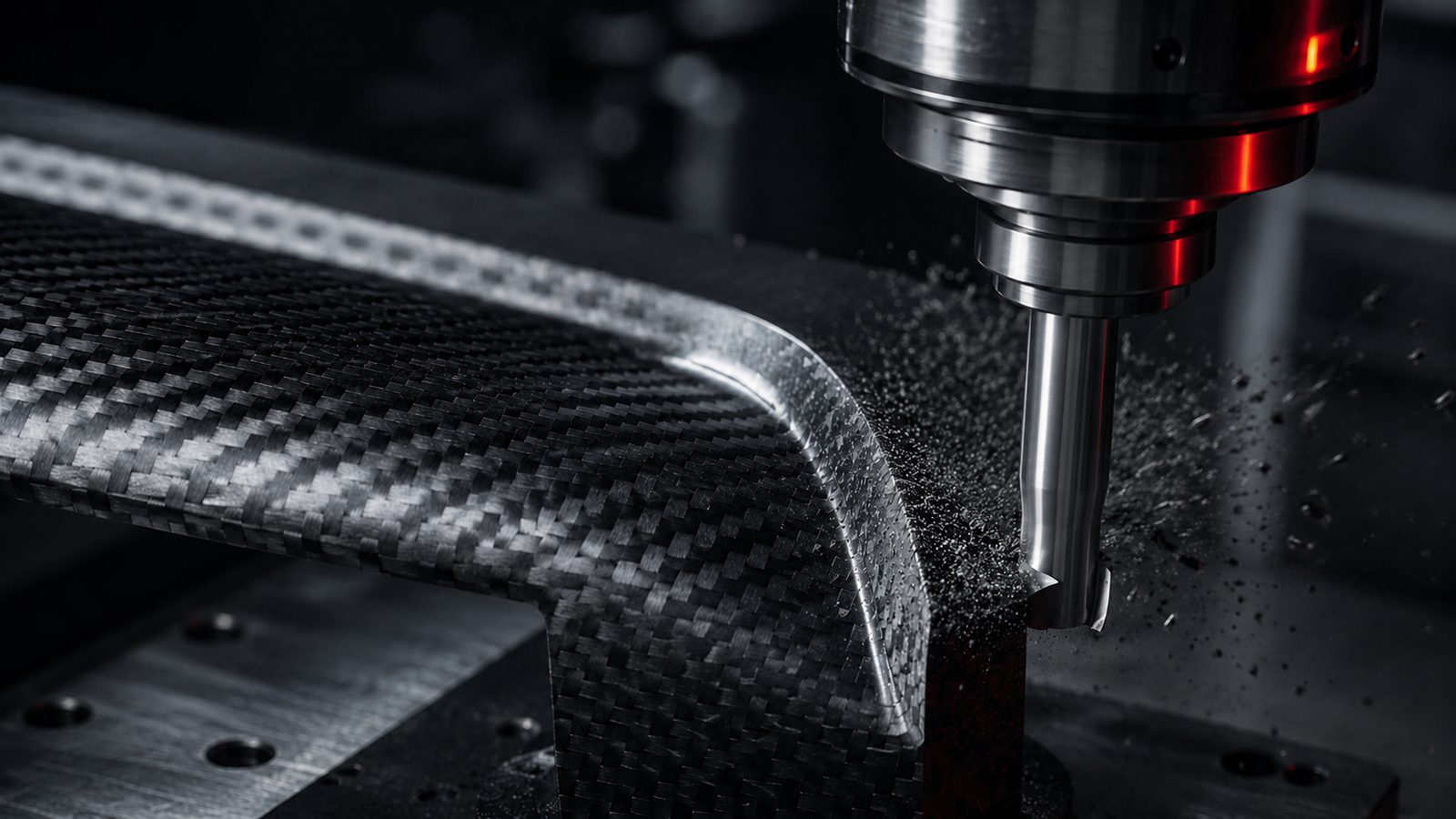
Trimming carbon-fiber-reinforced polymer (CFRP) aircraft skins is brutal on tooling — delamination, uncut fibers, and fiber pull-out plague the cut. One aircraft manufacturer was burning through a carbide burr per part across three separate operations until they switched to RobbJack's CPCD-203 Series PCD trimming tool.
Single-pass PCD trimming replaced two rough passes plus an abrasive finish pass.
The challenge
CFRP's strength-to-weight ratio makes it ideal for airframes — and notoriously hard to machine cleanly. The manufacturer's process needed two rough passes followed by a finishing pass with an abrasive diamond grinding tool: three operations to finish every part, one carbide burr consumed per part, and expensive scrap along the way.
RobbJack's response
The CPCD-203 Series PCD trimming tool was engineered specifically for composites. A built-in drill point prevents delamination on plunge, and RobbJack's PCD manufacturing improves edge quality, adhesion, and heat resistance — consolidating rough and finish into a single pass.
The results
- One CPCD router cut 23 parts without a tool change — the work of 23 previous tools.
- Per-part tooling cost dropped from $48 to $18.
- $216,000 in annual savings.
- Secondary operations eliminated; production capacity up 4×.
Consolidating to a single-pass PCD tool didn't just cut cost — it removed an entire bottleneck from the line.
Tools in this story
Have a job like this?
Tell us your material and operation — our application engineers will recommend the tool and the speeds & feeds to run it.